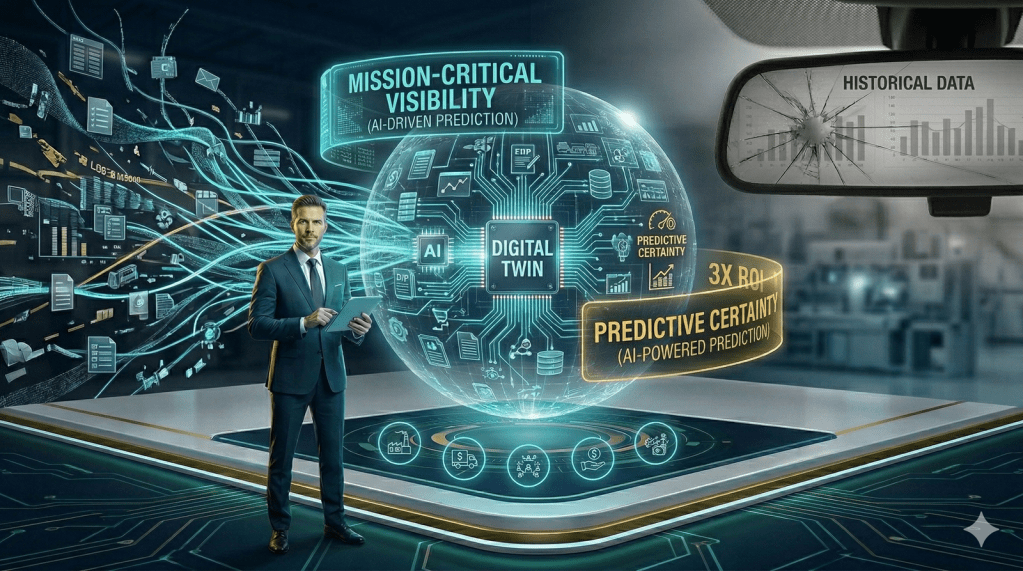
In 2026, looking at a dashboard is like reading yesterday’s newspaper to predict today’s weather. It tells you where you were, but it is blind to where you are going. For decades, we chased ‘Real-Time Data,’ only to realize that by the time data is ‘real-time’, the opportunity to act has often already passed. The era of the static observer is over. We have entered the age of the Digital Twin—not as a mirror of what is happening, but as a cognitive engine that decides what happens next.
1. The Generational Shift: From Firefighting to Fire-Proofing
In traditional factories and logistics hubs, we have long relied on Dashboards. But a dashboard is essentially a “rearview mirror”—it tells you how much stock you already lost or which machine just broke.
By 2026, this information latency has become the ultimate cost-sink. The transition from Dashboards to Digital Twins marks our evolution from being “Data-Driven” to “Cognitive-Driven.” It is no longer just a static 3D model; it is a “Digital Brain” that thinks in real-time and simulates the future before it happens.
2. The “Thinking” Network: From Cold Code to Strategic Ally
In the past, the pain point of IT systems was “Too much data, too little insight.” Today’s leading architectures (powered by 6G and AI) grant Digital Twins the ability to understand Intent.
- Before: The system detects a bottleneck, sends an alert, and waits for a human to fix it.
- Future: The system predicts a logistics surge 10 minutes in advance and autonomously reconfigures routes and resources before the congestion manifests.
- The Bottom Line: As a IT manager, I no longer manage systems that just “report”; I orchestrate systems that achieve Zero-Error alignment with global business goals.
3. De-Risking Reality: Iterating at the Speed of Software
Why are global enterprises investing millions in Digital Twins? Because it is the most effective “Risk Insurance” available. In high-stakes industries like food science or precision manufacturing:
- The Traditional Way: Physical trials are expensive and slow. Launching a new product could cost $4M and take 3 years of trial and error.
- The Digital Twin Way: We “fail” 10,000 times in a virtual environment first.
- The ROI: A 3x reduction in R&D costs and a 75% faster time-to-market. This isn’t just a tech upgrade; it’s a fundamental shift in market entry strategy.
4. The “Executable” Twin: Empowering the Frontline with “God-View”
Digital Twins are no longer the exclusive playground of PhDs in labs. Through Natural Language Interfaces, a shop-floor operator can now simply ask the system: “If I increase this machine’s speed by 10%, will it delay this afternoon’s delivery?”
This “Virtual Sensor” technology allows us to monitor data in extreme environments where physical hardware would melt or fail. It transforms cold spreadsheets into actionable advice that every employee can understand and execute.
5. Redefining Leadership: From Firefighter to System Architect
The most critical takeaway is this: Digital Twins are not replacing humans; they are liberating human potential.
- Past: Project Managers spent 80% of their time collecting reports and verifying data.
- Future: With Self-Healing capabilities, the system handles routine failures autonomously.
- My Vision: The value of a Senior IT Manager in 2026 lies in “Defining Intent.” We are moving away from fixing what is broken and moving toward designing Closed-Loop Systems that are engineered to never fail in the first place.
Conclusion: From Tracking the Past to Engineering the Future
Digital Twins are not just a technical upgrade; they are a management revolution.
In 2026, the role of a Senior IT Leader is no longer to “watch the numbers” on a dashboard. It is to define the intent of a self-healing system. My mission is simple: to move the operations from reactive firefighting to predictive certainty.
We are no longer asking “What happened?” We are now deciding “What will happen.” This is how we transform industrial complexity into a massive competitive advantage.

 wuenqiinsights
Leave a comment