
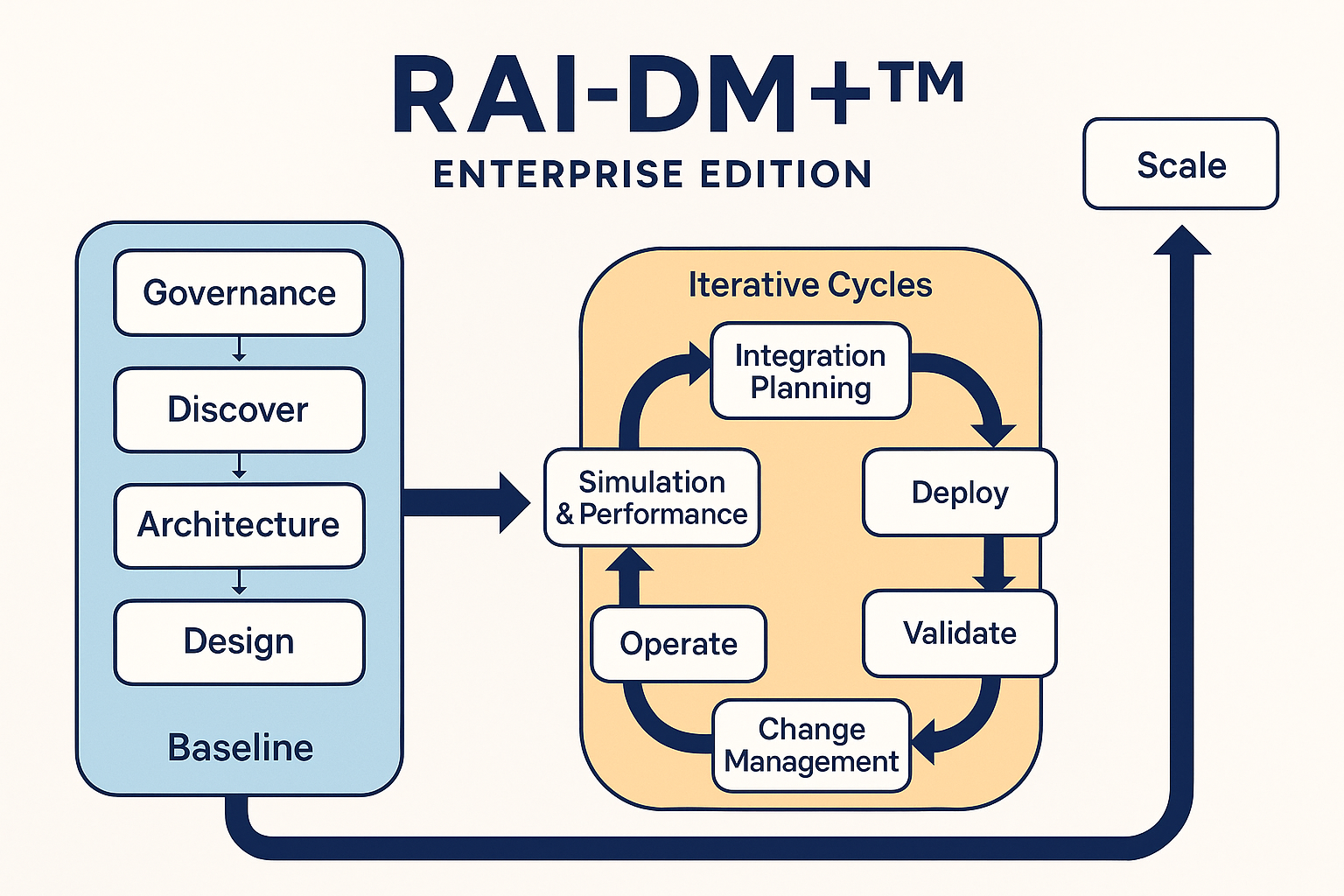

🌐 RAI-DM+™ Agile Playbook
Robotics & AI Deployment Method — Enterprise Edition (Agile-First)
RAI-DM+™ is an enterprise-grade deployment framework designed for modern Robotics & AI programs.
It combines Predictive baseline planning with Agile iterative execution, enabling organizations to deliver AMR/AGV/AMMR, AI vision, SLAM, path-planning and system integration projects safely, efficiently, and at scale.
The framework is built for:
- Multi-vendor robotic ecosystems
- High-uncertainty environments (warehouses, factories, retail, healthcare)
- Continuous improvement cycles (SLAM, AI models, workflows, human–robot interaction)
- Enterprise IT/OT integration (WMS/ERP/MES/PLC/Cloud/Edge)
RAI-DM+™ ensures governance stability, technical coherence, and rapid adaptation throughout the project lifecycle.

🔵 1. Baseline Setup (Predictive Foundation)
Establish once. Adjust as needed during Agile cycles.
This first block provides structural stability so the project can adapt without losing alignment.
1.1 Governance & Alignment
Define project governance, stakeholders, decision rights, risk model, documentation standards and architectural principles.
1.2 Discover
Identify business value, operational bottlenecks, user requirements, success metrics, ROI drivers, and automation maturity level.
1.3 Architecture
Create the unified system blueprint (robots, AI modules, network, safety, API flows, data ownership, edge/cloud strategy).
1.4 Initial Design
Produce the first version of solution design, workflows, SLAM strategy, missions, traffic rules, AI components, and safety concepts.
🔹 These four steps form the Project Management Baseline.
🔹 They are not frozen; they evolve across sprints.
🟠 2. Agile Iterative Cycles (Core Engine of RAI-DM+™)
This loop repeats continuously until operational performance stabilizes.
Each iteration may cover a single robotic workflow, a batch of missions, a new integration, a new SLAM tuning, or an AI capability.
2.1 Integration Planning
Refine interfaces (WMS/ERP/PLC/MES/Cloud), update mapping tables, define triggers, error handling, API versioning and test scripts.
2.2 Deploy
Incremental deployment of robots, missions, maps, AI models or workflows.
Small-scale deployments reduce risk and accelerate feedback.
2.3 Validate
Run SAT/UAT-style micro-tests for each iteration:
- Throughput
- Success rate
- Stability
- Failure recovery
- Safety behavior
2.4 Change Management
Continuous stakeholder engagement, operator training, union considerations, communication, hypercare support and adoption monitoring.
2.5 Operate
Real-world monitoring:
- KPI dashboards
- Robot queues
- AI drift detection
- SLAM/map health
- Capacity predictions
- ROI tracking
2.6 Simulation & Performance Modeling
Every major change is simulated before deployment using Gazebo / Isaac Sim:
- Traffic flow
- Deadlock detection
- Scheduler performance
- Peak-load scenarios
- Multi-robot coordination
🔁 Cycles repeat until the integrated system meets or exceeds SLA & business targets.
🟡 3. Scale (Enterprise Replication Layer)
Once the solution is stable and validated, the framework supports enterprise-wide rollout:
3.1 Replication Framework
Templates, checklists, deployment kits and standardized interfaces for rapid multi-site deployment.
3.2 Multi-Site SLAM Strategy
Shared maps, consistent traffic logic, cross-site naming conventions, and update governance.
3.3 AI Model Lifecycle Strategy
Versioning, retraining, drift management, performance evaluation and continuous improvement.
3.4 Automation Roadmap
Defines future upgrade paths for robots, AI modules, infrastructure and operational models.
🎯 Why RAI-DM+™ Works
✔ Predictive stability where necessary
(Governance, Architecture, Safety, Risk, Integration Standards)
✔ Agile speed where uncertainty is high
(SLAM tuning, mission design, AI model iteration, human-robot workflows)
✔ Scalable and repeatable deployment
Across warehouses, factories, retail stores, hospitals and logistics centers.
✔ Enterprise-ready
Built for multi-vendor ecosystems, complex integrations and global operations.
✔ Reduces deployment failure risk
Through simulation-first design, continuous testing and iterative validation.
🧭 RAI-DM+™ in a Single Sentence
A hybrid Predictive + Agile deployment method enabling organizations to safely and rapidly scale Robotics & AI across their operations.